
Eren, Remzi Onur - CAP 43
TBK1 and IKKε in Inflammation and Cell Death: From Mechanism to Therapy

Introduction
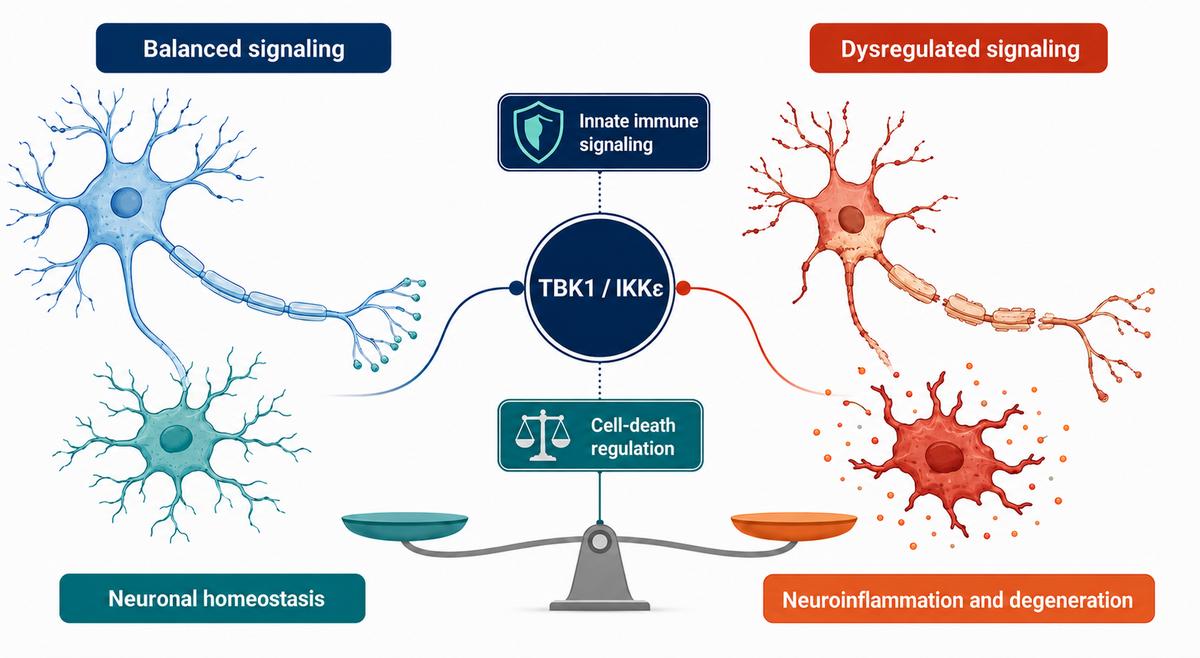
The coordinated regulation of inflammatory signaling and regulated cell death is considered crucial for maintaining tissue homeostasis during ageing and disease. Our group investigates the non-canonical IKK-related kinases TANK-binding kinase 1 (TBK1) and IκB kinase ε (IKKε), which are important regulators of innate immune sensing, type I interferon responses and cell-fate decisions. Our findings indicate that TBK1 and IKKε restrict inflammatory cell death through RIPK1-dependent mechanisms and may additionally limit RIPK1-independent inflammation in a tissue-specific manner. The association of TBK1 loss-of-function variants with amyotrophic lateral sclerosis and frontotemporal dementia further highlights the potential importance of TBK1 in nervous-system homeostasis. However, the mechanisms through which TBK1 and IKKε may influence neuronal function, neuroinflammation and degeneration remain insufficiently understood. The CAP project will investigate these mechanisms by integrating genetic models with molecular profiling, histological analyses and neurophysiological measurements.
Figure 1
Aims
The project aims to clarify how TBK1 and IKKε contribute to tissue and neuronal homeostasis during aging and disease. It will examine how alterations in their activity may influence inflammatory signaling, cell-death regulation and nervous-system function. Overall, we seek to improve our understanding of the context-dependent roles of these kinases and their potential relevance to inflammatory and neurodegenerative disorders.
Clinical relevance
TBK1 and IKKε function at the interface of innate immune signaling, cell-death regulation and neuronal homeostasis. Loss-of-function variants in TBK1 are associated with amyotrophic lateral sclerosis and frontotemporal dementia, highlighting the importance of adequate TBK1 activity for nervous-system integrity. Conversely, excessive or sustained TBK1 activity may promote chronic inflammatory signaling and could contribute to neuronal dysfunction and tissue damage. These observations suggest that balanced TBK1 and IKKε activity are important for maintaining tissue homeostasis. With support from the CMMC Career Advancement Program (CAP), we investigate how balanced TBK1 and IKKε signaling may support neuronal function and how its disruption could contribute to neuroinflammation and tissue degeneration. The resulting insights may support the development of more selective approaches for neuroinflammatory and neurodegenerative disorders.
Lab Website
Lab Website is in preparation.
Affiliations - Remzi Onur Eren
- Institute for Genetics, Department of Biology, University of Cologne, Cologne, Germany
- Cologne Excellence Cluster on Cellular Stress Responses in Aging-Associated Diseases (CECAD), University of Cologne, Cologne, Germany
- Center for Molecular Medicine Cologne (CMMC), University of Cologne, Cologne, Germany
Publications generated with CMMC affiliations
2026
Publications with CMMC affiliations will be listed as soon as available