
Dafsari, Hormos C - CAP 42
Cellular Resilience Mechanisms and Molecular Modulation
PD Dr. Hormos C Dafsari
Dept. of Pediatrics and Adolescent Medicine
CMMC - PI - CAP 42
show more…
Dept. of Pediatrics and Adolescent Medicine
Kerpener Str. 62
50937 Cologne
Introduction
This research group studies a central question in translational neuroscience: why do some neurons remain resilient for decades, whereas other neurons fail when cellular quality-control systems are only partially impaired? We focus on autophagy - the lysosome-dependent pathway that removes damaged proteins and organelles - and on the intracellular trafficking steps that determine whether this recycling process is completed successfully.
Rare monogenic disorders provide uniquely precise models. One of our principal models is EPG5, a tethering factor required for selective autophagosome-lysosome fusion. Mostly truncating, biallelic variants cause the childhood-onset multisystem disorder Vici syndrome, while our recent work extended the clinical spectrum to early-onset parkinsonism in patients with missense biallelic variants and parkinsonism-dementia in monoallelic relatives (allele-carriers). Across publications in cell biology journals (Autophagy, Nature Communications) and neurology journals (Brain, Annals of Neurology), we linked EPG5 dysfunction to impaired mitophagy, mitochondrial calcium signalling, cytosolic mitochondrial DNA, cGAS-STING/TBK1-driven inflammation, integrated stress signalling, proteotoxic stress, and dopaminergic neuronal loss.
We use patient-derived cells, induced pluripotent stem cell-derived neurons and long-term brain organoids to reconstruct these disease trajectories in human tissue. We also work in the roundworm C. elegans to leverage the power of molecular genetics for in vivo assays. We combine clinical phenotyping with cell biology, mitochondrial and autophagic flux assays, advanced imaging, inflammatory signalling, and RNA therapeutics.
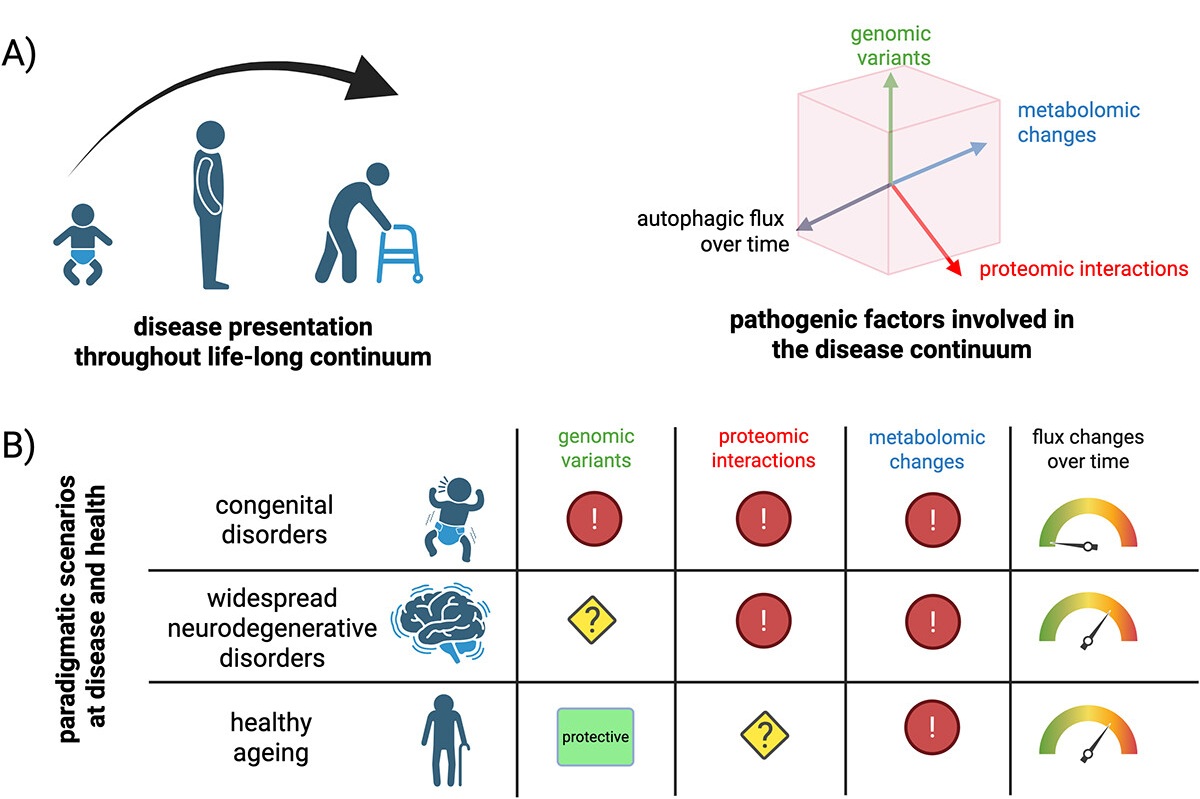
Our rare-to-common strategy studies monogenic childhood disorders as distinct models and discovery engines for cell biological mechanisms that determine efficient development and detrimental vulnerability to age-related neurodegeneration. This strategy addresses the modulation of organellar health during periods of stress to understand biomarkers and processes in cellular resilience.
Figure 1
Aims
1. Define how EPG5 gene dosage shapes neuronal resilience. In patient-derived iPSC-neuron and long-term brain-organoid models, we examine autophagosome-lysosome fusion, mitophagy and cell-type-specific vulnerability, with particular emphasis on dopaminergic neurons.
2. Resolve the autophagy-mitochondria-inflammation axis over time. We investigate the timing of defective organelle clearance leading to mitochondrial dysfunction, mtDNA leakage, cGAS-STING/TBK1 activation and the integrated stress response, and how these events relate to accumulation of alpha-synuclein, tau and amyloid-associated pathology.
3. Develop mechanism-guided therapies. We conceive and optimize splice-switching antisense oligonucleotides (ASOs) and small-molecule splicing and pathway modulators, then test whether early intervention prevents disease trajectories and whether later intervention can restore autophagic flux and attenuate established pathology.
Together, these aims serve as a human experimental platform for collaborative target validation, biomarker studies and preclinical therapeutic testing across autophagy-related neurodevelopmental and neurodegenerative disorders.
Clinical relevance
Neurodegenerative disorders represent a major and growing clinical burden, yet mechanisms determining individual vulnerability and timing of onset remain insufficiently understood. Autophagy impairment is a modifiable contributor as it affects proteostasis, organellar health and integrated stress signalling. Our work programme provides a clinically anchored route to mechanism by leveraging EPG5 as a human gene-dosage model that bridges rare childhood-onset neurogenetic disease and more widespread adult-onset neurodegeneration. This rare-to-common strategy is founded in monogenic models, fundamental pathomechanisms and established biomarkers to enable precision-medicine in patients and families.
Paradigmatic metabolic diseases in childhood mostly present with multisystem disorders, particularly in patients with innate errors in autophagy and intracellular trafficking that show a wide disease spectrum from neurodevelopmental disorders, neurodegenerative disease courses, hypopigmentation and immune deficiency. This research group is embedded offering specialized care at the Division of Pediatric Neurology with its neurogenetic, neuromuscular, immunology and metabolic clinics, including translational pipelines deeply embedded into the translational research campus with the Center for Rare Syndromal Diseases and Center for Gene and Cell Therapy at the University of Cologne.
The project seeks targeted treatments that correct defective RNA processing or restore cellular clearance rather than suppressing a single downstream marker. Antisense oligonucleotides (ASOs) already have regulatory and clinical precedents in neurological disease, making them a pragmatic route from molecular diagnosis to precision therapy.
Lab Website
For more information, please check the Website of the Research Group.
Affiliations - Hormos C Dafsari
- Department of Pediatrics, University Hospital Cologne
- Center for Rare Diseases Cologne, University Hospital Cologne
- Center for Molecular Medicine Cologne (CMMC), University of Cologne
- Center for Gene and Cell Therapy Cologne, University Hospital Cologne
- Max-Planck-Institute for Biology of Ageing, Cologne
- King's College London
Publications generated with CMMC affiliations
2026
Publications with CMMC affiliations will be listed as soon as available