
Hübbers, Christian U - assoc. RG 80
Metabolic Reprogramming and Treatment Resistance in HPV-Positive Oropharyngeal Squamous Cell Carcinoma

PD Dr. Christian U Hübbers
Dept. of Otorhinolaryngology, Head and Neck Surgery
CMMC - assoc. RG 80
show more…
Dept. of Otorhinolaryngology, Head and Neck Surgery
Introduction
Our research focuses on the molecular mechanisms that shape the biological behaviour of human papillomavirus-positive oropharyngeal squamous cell carcinoma (HPV+ OPSCC). Although HPV+ OPSCC generally has a better prognosis than HPV-negative head and neck cancer, a clinically relevant subgroup of patients develops recurrent disease, distant metastases, or resistance to standard therapies. This highlights the need for improved biomarkers and a deeper understanding of the tumour-specific mechanisms that drive aggressive disease.
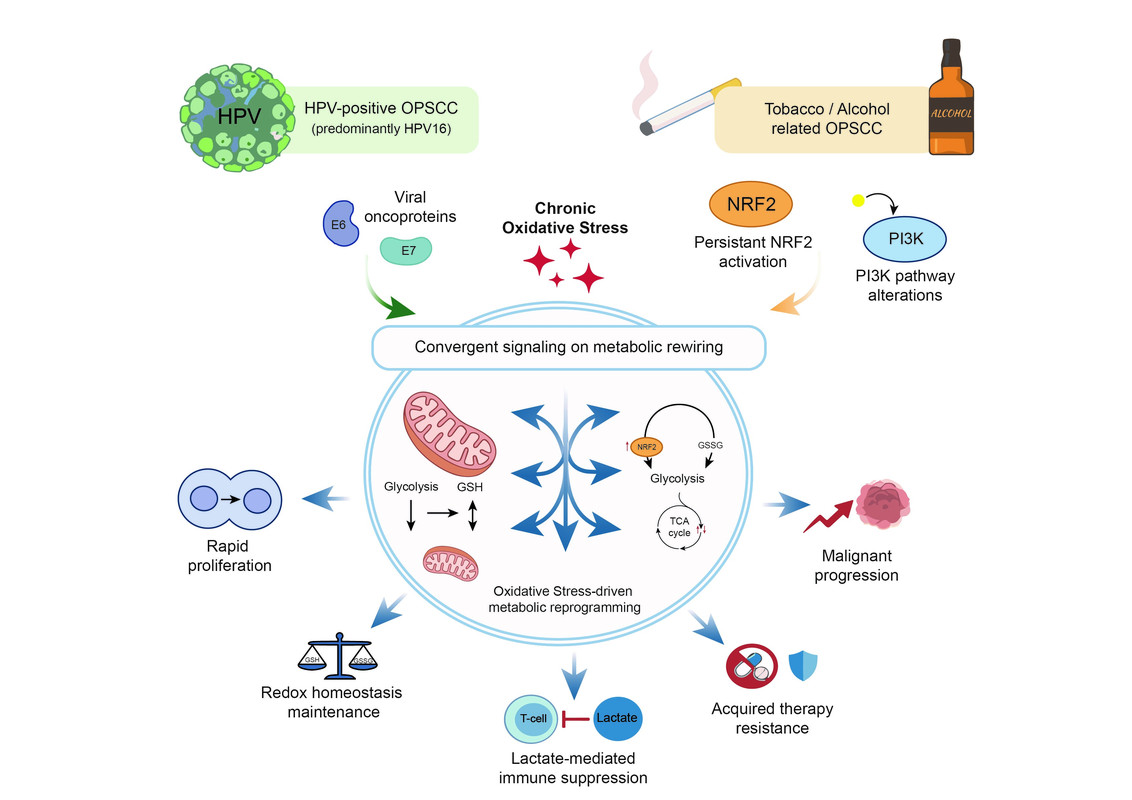
A central interest of our work is metabolic reprogramming in subgroups of HPV+ OPSCC. Tumour cells adapt their metabolism to support proliferation, survival under stress, and resistance to therapy. In HPV+ cancers, viral oncogene expression, oxidative stress responses, mitochondrial function, and cellular detoxification pathways may interact to create distinct metabolic vulnerabilities. We are particularly interested in how HPV16-related factors influence redox balance, energy metabolism, and stress adaptation in tumour cells.
Our research investigates how oxidative stress and altered metabolic signalling contribute to treatment resistance. We study pathways involving NRF2-dependent stress responses, aldo-keto reductases such as AKR1C1 and AKR1C3, mitochondrial metabolism, glycolytic adaptation, and the regulation of viral gene expression. These mechanisms may help tumour cells tolerate radiation, chemotherapy, hypoxia, and other microenvironmental stressors.
By combining molecular biology, tumour cell models, patient-derived tissue analyses, and translational approaches, our goal is to identify biomarkers that distinguish favourable from high-risk HPV+ OPSCC. In the long term, this work aims to support more precise risk stratification and to reveal new therapeutic strategies that exploit metabolic and oxidative stress-related vulnerabilities in HPV-associated head and neck cancer.
Overall, our research seeks to bridge basic molecular mechanisms and clinical relevance, with the aim of improving personalized treatment concepts for patients with HPV+ OPSCC.
Figure
Affiliations
- Center for Molecular Medicine Cologne (CMMC)
- Department of Otorhinolaryngology, Head and Neck Surgery, Medical Faculty, University of Cologne
- Molecular Head and Neck Oncology, Translational Research in Infectious Diseases and Oncology (TRIO) Research Building, University Hospital of Cologne
Publications generated during 1/2026 - 12/2028 with CMMC affiliations
Publications will be listed as soon as available.