
Event Details:
CMMC Seminar Series
in cooperation with the Immunology Seminar Series and the Center for Infectious Diseases (CIM)
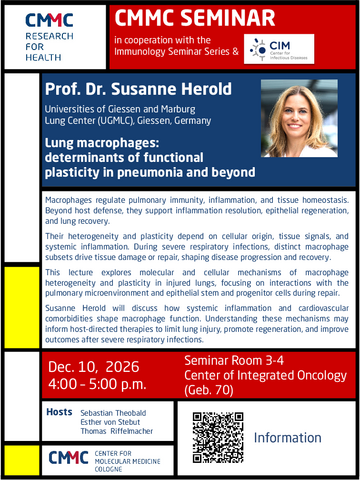
Lung macrophages: determinants of functional plasticity in pneumonia and beyond
Susanne Herold,Universities of Giessen and Marburg, Lung Center (UGMLC), Giessen - DE
1Dept. I for Internal Medicine 2Dept. of Dermatology and Venerology 3Dept. III for Internal Medicine
Additional Information:
Lung macrophages: determinants of functional plasticity in pneumonia and beyond
Presented by Prof. Susanne Herold
Abstract of the Presentation:
Macrophages are key regulators of pulmonary immunity, inflammation, and tissue homeostasis. Beyond their well-established role in host defense against respiratory pathogens, they contribute to the resolution of inflammation, epithelial regeneration, and restoration of lung function following injury. Their remarkable functional plasticity enables them to adapt to changing microenvironmental conditions and fulfill diverse, sometimes opposing roles during the course of pulmonary disease. Recent advances in single-cell technologies and experimental models have revealed substantial heterogeneity among lung macrophage populations, highlighting the importance of cellular origin, local tissue-derived signals, and systemic inflammatory cues in shaping macrophage identity and function. During severe respiratory infections, distinct macrophage subsets can promote either inflammatory tissue damage or regenerative processes, thereby critically influencing disease progression and recovery.
Professor Herold´s lecture will provide an overview of the cellular and molecular mechanisms governing macrophage heterogeneity and functional plasticity in the injured lung. Particular emphasis will be placed on the dynamic interplay between macrophages and the pulmonary microenvironment, including their interactions with epithelial stem and progenitor cells during tissue repair. Furthermore, the potential impact of systemic inflammatory conditions and cardiovascular co-morbidities on pulmonary macrophage function will be discussed. Understanding the mechanisms that determine macrophage responses in health and disease may open new avenues for host-directed therapeutic strategies aimed at limiting lung injury, promoting tissue regeneration, and improving outcomes following severe respiratory infections.
About Prof. Susanne Herold:
Professor Susanne Herold, MD, PhD, is a German physician-scientist recognized for her contributions to understanding how the immune system shapes lung injury and recovery during severe respiratory infections.
She is Professor of Internal Medicine, Infectious Diseases, and Experimental Pulmonology at Justus Liebig University Giessen and Director of the Dept. of Internal Medicine V, specializing in infectious diseases and infection control, at University Hospital Giessen. Working within the Universities of Giessen and Marburg Lung Center, she also serves as a spokesperson for the Cardio-Pulmonary Institute, an interdisciplinary research consortium supported through Germany’s Excellence Strategy.
Herold investigates the mechanisms underlying severe pneumonia and acute respiratory failure. Pneumonia is a common disease associated with substantial illness, mortality, and healthcare costs. Respiratory viruses play a central role, causing acute infections that can be severe and contributing to chronic disease. Her research examines how pathogens replicate in the lungs, how lung damage develops, and how tissue repairs itself following viral and bacterial pneumonia.
A particular focus is the role of immune cells, especially macrophages, in these processes. Her work aims to deepen our understanding of the underlying mechanisms and translate these insights into investigator-initiated clinical trials. These studies seek to limit pathogen spread, improve or restore host defenses, reduce acute and chronic organ damage, accelerate regeneration, and ultimately prevent long-term complications.
Herold’s work on virus-induced lung injury and the mononuclear phagocyte system has received national and international recognition. During the COVID-19 pandemic, she became recognized as a leading expert on SARS-CoV-2.
Her contribution to the scientific community includes research leadership, clinician-scientist training, and national collaboration; in 2026, she joined the spokesperson team of Germany’s COVIM immunity platform.
Her honors include election to the German National Academy of Sciences Leopoldina in 2025, recognition as a Fellow of the American Thoracic Society in 2024, and a LOEWE distinguished professorship awarded by the State of Hessen in 2022. Earlier awards include the German Society for Infectious Diseases’ Clinical Infection Research advancement prize in 2010 and the German Society of Internal Medicine’s Young Investigator Award in 2006.
Further information is available through her Giessen University profile, her research group website, and her Leopoldina profile.
Event Downloads:
Download