Event Details:
CMMC Advent Edition: Seminar & Get-Together
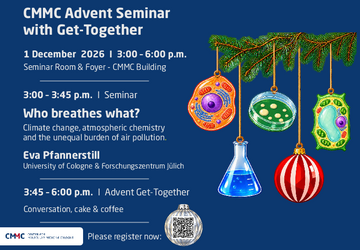
3:00–3:45 p.m. - Seminar
Who breathes what? Climate change, atmospheric chemistry and the unequal burden of air pollution.
Eva Pfannerstill - Institute for Geophysics and Meteorology, University of Cologne, DE and Institute of Climate and Energy Systems (ICE), Forschungszentrum Jülich, DE
3:45–6:00 p.m. - Advent Get-Together with coffee and delicious cake
Join us for CMMC Advent Networking with coffee and cake
Registration required!
Center for Molecular Medicine Cologne
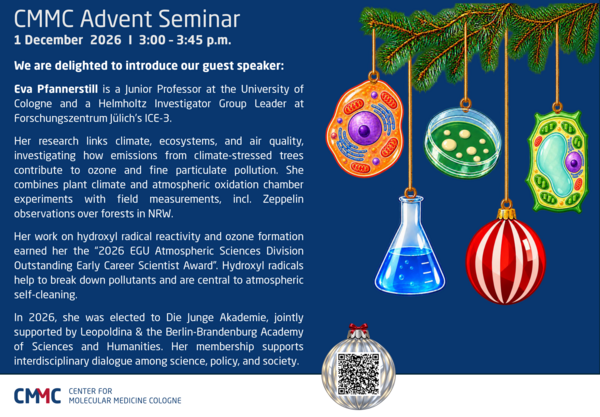
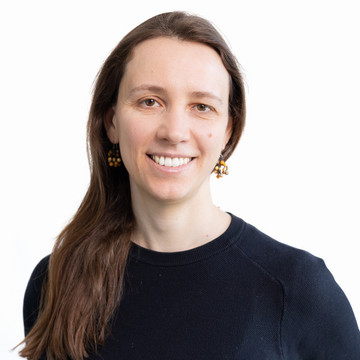
We are excited to introduce Eva Pfannerstill:
She is an atmospheric scientist connecting climate, ecosystems, and air quality and Junior Professor of Atmospheric Chemistry at the University of Cologne’s Institute of Geophysics and Meteorology and a Helmholtz Investigator Group Leader at Forschungszentrum Jülich’s Institute of Climate and Energy Systems – Troposphere (ICE-3). Her research examines how climate change affects emissions from vegetation and how these emissions influence atmospheric chemistry and air quality. She focuses particularly on volatile organic compounds released by trees under climate stress and their contribution to the formation of ozone and fine particulate matter. Her approach combines experiments in plant climate chambers and atmospheric oxidation chambers with field measurements, including Zeppelin observations over forests in North Rhine-Westphalia.
Contributions to Atmospheric Science
Pfannerstill is recognized for advancing understanding of ozone formation in both pristine and polluted environments. Her Amazon rainforest research helped reconcile measured atmospheric reactivity with its chemical sources and showed the effects of El Niño on tropical forest chemistry. During her postdoctoral research in the United States, she developed and applied aircraft-based emission measurement methods. This work demonstrated the importance of temperature-sensitive emissions for regional ozone formation, and thus links climate change with air pollution formation. Connecting socio-economic data with emission measurements, she also showed the unequal distribution of toxic emissions, which contributed to policy changes in California. Her work strengthens the scientific understanding of connections among ecosystems, climate, society and air pollution.
Academic Background
Pfannerstill earned her bachelor’s degree in Chemistry at Friedrich Schiller University Jena in 2013, including an exchange semester at Université de Montréal. She completed her master’s degree in Chemical Biology in 2015, with studies at Jena and the Royal Netherlands Institute for Sea Research.
In 2019, she received her doctorate in Chemistry from Johannes Gutenberg University Mainz, conducting her research at the Max Planck Institute for Chemistry. Her doctoral work focused on atmospheric reactivity in the Amazon rainforest and the Middle East. Following a postdoctoral appointment in Mainz, she held a Feodor Lynen Postdoctoral Fellowship at the University of California, Berkeley, from 2020 to 2023. Supported by the Alexander von Humboldt Foundation, her research used airborne measurements in California to investigate emissions and their implications for air pollution. She subsequently continued her career at Forschungszentrum Jülich and the University of Cologne.
An Award-Winning Early-Career Scientist
In 2026, Pfannerstill received the European Geosciences Union Atmospheric Sciences Division Outstanding Early Career Scientist Award, recognizing her contributions to atmospheric chemistry, particularly hydroxyl (OH) reactivity and ozone formation. Hydroxyl radicals initiate the breakdown of many atmospheric pollutants and are therefore central to the atmosphere’s chemical self-cleaning capacity. Earlier that year, she was also elected to Junge Akademie | Mainz, the early-career academy of the Academy of Sciences and Literature | Mainz, in recognition of her scientific achievements.
Connecting Science and Society
In 2026, Pfannerstill was additionally elected to Die Junge Akademie, jointly supported by the German National Academy of Sciences Leopoldina and the Berlin-Brandenburg Academy of Sciences and Humanities. Her five-year membership provides a platform for bringing atmospheric and climate research into interdisciplinary dialogue with policy and society. Her listed research interests include environmental justice and air quality, and she participates in the academy’s working groups on science policy, sustainability, and engaged science - extending her engagement beyond disciplinary boundaries.